














This website is intended for healthcare professionals in Switzerland only.


Current information about ovarian cancer
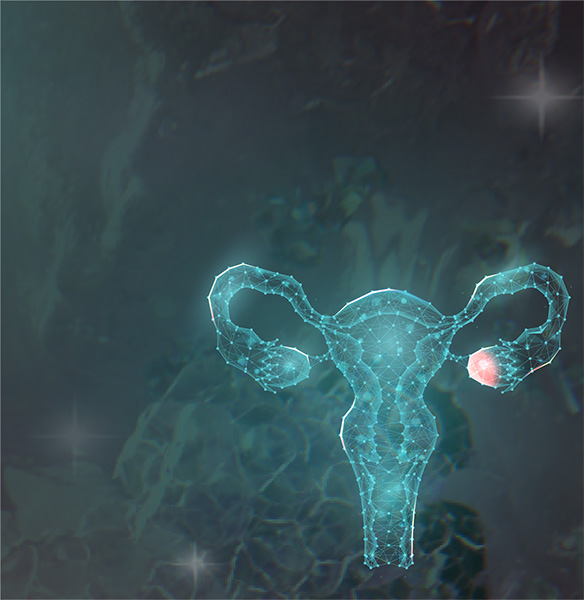
Ovarian cancer is a type of cancer that develops in the female reproductive organs that produce and store eggs (ovaries). It develops when abnormal ovarian cells divide and multiply in an uncontrolled manner.1
Around 90% of ovarian cancers are epithelial tumours, which mainly occur in women after the menopause. Other rare types of ovarian cancer include germ cell tumours and sex cord stromal tumours.2
Ovarian cancer is the deadliest type of cancer in gynaecology. Less than half of patients survive more than five years after diagnosis.2 The survival rate for early-stage ovarian cancer (stages 1 and 2) is 80-90%, but only 25% for late-stage ovarian cancer (stages 3 and 4).3
More than 75% of affected women are diagnosed at an advanced stage as the disease is usually asymptomatic in the early stages and the symptoms are non-specific in the late stages of the disease.2
In Switzerland, 600 women are diagnosed with ovarian cancer every year and 390 women die from the disease. According to current Swiss figures, the 5-year survival rate is 47%.4
The greatest risk factors for ovarian cancer are advancing age and a family history of ovarian and breast cancer.2 Genetic risk factors include mutations in the BRCA1 or BRCA2 genes (21% of patients).5
In addition, a high number of ovulations over the course of life (early first period, late menopause, childlessness) appears to increase the risk. Excessive obesity and diabetes also increase the likelihood of developing ovarian cancer.6
There is no effective screening test, so the most important prospect for early diagnosis is improved detection of symptomatic cancer.3
At diagnosis, a test for BRCA mutations is recommended regardless of the stage.9
The stage of ovarian cancer determines treatment and is also the most important prognostic factor.10 The stage is determined by surgery, through which the ovaries and other gynecological organs, as well as lymph nodes and other tissues to which the cancer may have spread, can be examined and removed.10
References:
- Ovarian Cancer, last revised in 2024. Available online at: https://www.mdanderson.org/cancer-types/ovarian-cancer.html. Last accessed on: 06/06/2024.
- Doubeni CA, et al. Diagnosis and Management of Ovarian Cancer. Am Farn Physician. 2016 Jun 1;93(11):937-44.
- Gajjar K, et al. Symptoms and risk factors of ovarian cancer: a survey in primary care. ISRN Obstet Gynecol. 2012;2012:754197.
- Cancer in Switzerland: key figures; Swiss Cancer League, last revised in November 2025. Available online at: https://www.krebsliga.ch/ueber-krebs/zahlen-fakten/-dl-/fileadmin/downloads/sheets/zahlen-krebs-in-der-schweiz.pdf. Last accessed on: 29.05.2026.
- Harter P, et al. Prevalence of deleterious germline variants in risk genes including BRCA1/2 in consecutive ovarian cancer patients (AGO-TR-1). PLoS One. 2017;12(10):e0186043.
- Swiss Cancer Report 2021, Federal Office of Public Health, published on 14/10/2021, last updated on: 31/05/2022. Available online at: https://www.bfs.admin.ch/asset/de/19305696. Last accessed on: 29.05.2026.
- Bray F, et al. Global cancer statistics 2022: GLOBOCAN estimates of incidence and mortality worldwide for 36 cancers in 185 countries. CA Cancer J Clin. 2024 Apr 4.
- Dilley J, et al. Ovarian cancer symptoms, routes to diagnosis and survival - Population cohort study in the 'no screen' arm of the UK Collaborative Trial of Ovarian Cancer Screening (UKCTOCS). Gynecol Oncol. 2020 Aug;158(2):316-322.
- NCCN Guidelines for Patients, last revised in 2025. Available online at: https://www.nccn.org/patients/guidelines/content/PDF/ovarian-patient.pdf. Last accessed: 29.05.2026.
- O'Shea AS. Clinical Staging of Ovarian Cancer. Methods Mol Biol. 2022;2424:3-10.
Useful product information
CH-12868 Revision date 06/2026
